
4 tips for the VCE French written exam
The VCE French written exam is traditionally the last exam of the VCE season — and for many students, the finish line can't come soon enough.
C'est la dernière ligne droite! (It's the final stretch.)
Whether you're feeling quietly confident or running on caffeine and nerves, these 4 tips will help you walk into that exam room prepared — and walk out relieved.
Looking for extra support before the exam? Online 1:1 VCE French tutoring is available — get in touch to book a session.
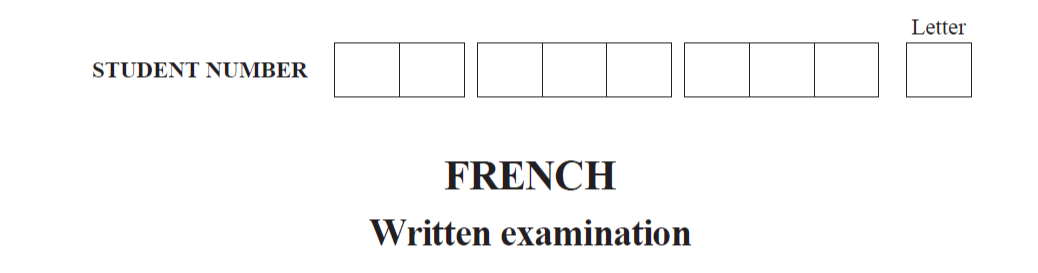
Become familiar with the VCE French Written Exam
This might sound obvious when you have been preparing for the VCE French exam for 2 years. However, it is crucial to become familiar with the exam: its structure, type of tasks, as well as its visual aspect. The more familiar you are with it, the easier the exam will feel as you will know exactly what type of task to expect in each section.
The VCE French written exam lasts for 2 hours and 15 minutes and consists of 3 distinct sections.
Section 1: listening comprehension
This is a listening and responding task in two parts. For each part, an audio document is played twice. Pay attention to the language required to answer each question (English for part 1, French for part 2).
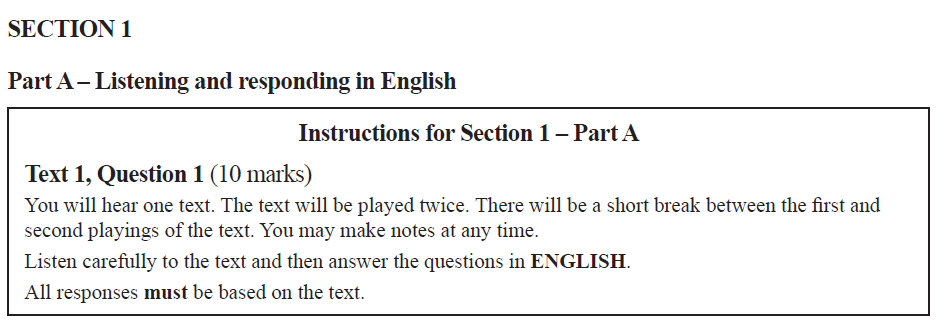
Section 1 of the VCE French Written exam
Section 2: reading comprehension
Part 1 is a multimodal task: listen to an audio document, then read a written text on a related topic, to answer questions in English.
Part 2 requires the student to produce a text in French, of approximately 150 words, forming their ideas, opinions and arguments on a written text.
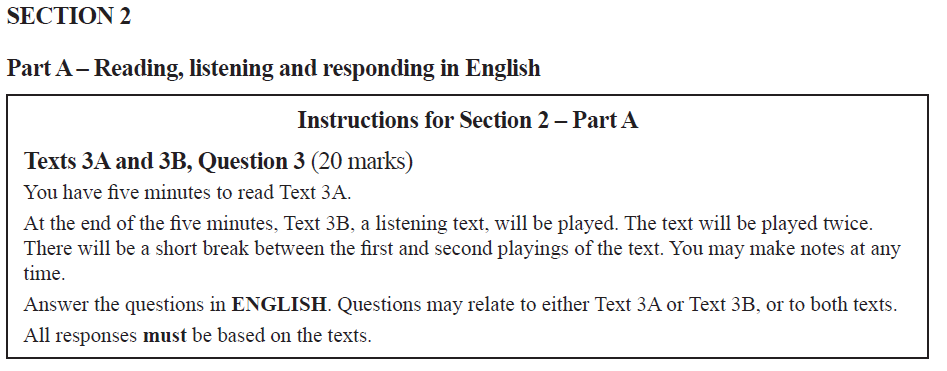
Section 2 of the VCE French Written exam
Section 3: writing
The student must choose one of the four writing tasks offered and write a response, in French, of 200 to 300 words.
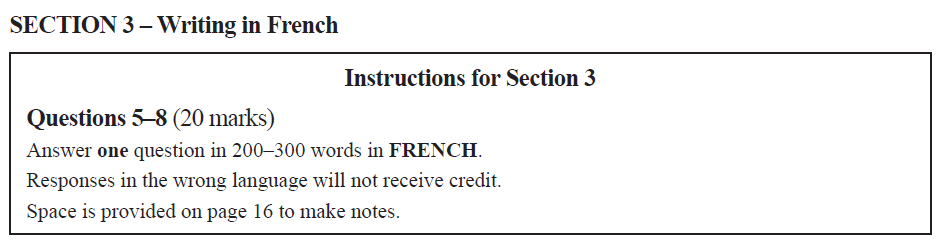
Section 3 of the VCE French Written Exam
Revise conjugation
Revise conjugation for the VCE French Written exam
After a few years of learning French, it is quite common to forget how to conjugate some of the first verbs you’ve learned. Stress can also cause forgetting even the most known and used verbs temporarily. What’s the difference between “avoir” and “aller”, already?
Revise the conjugation of the most common French verbs and make conjugation become an automatism. By doing so, you will also increase your vocabulary and improve your understanding of written and audio documents.
Practise writing in French
Both section 2 and 3 of the VCE French written exam contain a writing task of 150 to 300 words, for a 2 hours long exam. Such a short time cannot be spent trying to understand the instructions.
Practising writing in French regularly helps create good writing habits and makes writing more fluid and effortless.
Understanding the 5 styles of writing as well as knowing the main features of each text type helps choose an inspiring topic in Section 3 and craft a text containing all the required features.
5 styles of writing
There are 5 examinable styles of writing for the VCE French written exam : imaginative, evaluative, persuasive, informative and personal. These writing styles are all practised and evaluated during French Units 1, 2, 3 and 4, including during SACS.
Text types
14 different text types are listed as types the students should be able to produce at the end of VCE French Unit 4.
These types are: Article, Autobiographical/biographical extract, Blog, Brochure/leaflet, Conversation, Email, Interview, Journal entry, Letter (formal/informal), Report, review, Roleplay, Script for a film, play or podcast, Short Story.
Practise listening
Practising listening for the VCE French written exam
Listening is, by far, the most intimidating task of the VCE French written exam. Both section 1 and 2 contain a listening task, with 3 different audio documents for a total of 4.5 to 5 minutes. Practising listening to a variety of audio texts is the best way to prepare for this task. Get every opportunity to listen to something in French and train your ear to the sounds of the French language. Listen to French music or podcasts and watch films or series to get used to the specific music and rhythm of the French language.
Practise listening
Train for the exam by working through the oral comprehension documents in your textbook and try the past exams if you haven’t done so in class already. The more you practise listening, the easier it becomes to hear distinct words in a sentence and be comfortable not understanding every word, while still being able to get the general meaning of a text.
The VCE French written exam covers a lot of ground — listening, reading, and writing — but none of it is out of reach with the right preparation. Familiarise yourself with the exam structure, revise your conjugation, practise writing regularly, and train your ear. Do that consistently, and you'll walk in knowing exactly what to expect.
Bonne chance — you've got this.
Need a hand pulling it all together before exam day? Book a VCE French tutoring session and let's make the most of the time you have left.
Find past examinations and samples here, and the VCE French written exam specifications there.