
French Travel Language Basics: Your 8-Week Plan
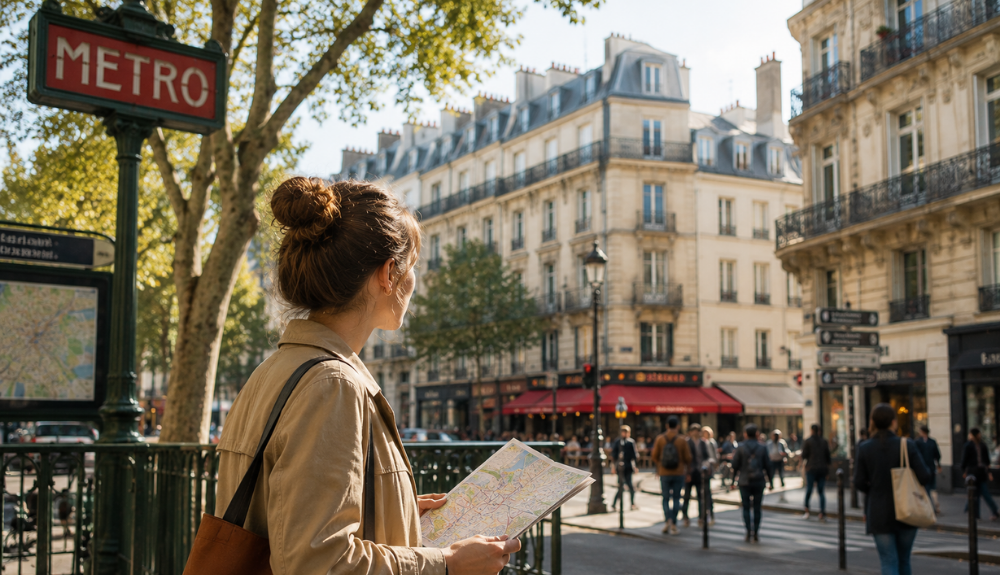
Basic French Phrases for Travel—In 8 Weeks!
Are you travelling to France soon? Would you like to refresh or learn some French travel language basics before you go?
Well, here's an 8-week plan you can follow to get ready before landing in Paris! I promise that by the end of it, you'll be able to order a baguette—and much more, too. 😉
Before you start learning French for travel…
First of all, let's take the pressure off: by the end of these 8 weeks, the goal isn't to be bilingual. You just need to be able to navigate everyday situations during your trip to France with confidence!
To make the most of this 8-week plan, here's the strategy I recommend following each week:
Take lessons with a French tutor once a week. 🗣️
Review for 15 to 20 minutes every day—repetition is key. 📒
Listen to a Francophone podcast or watch French videos once a week. 👂
Practise speaking with your tutor or language partner, and don't be afraid to make mistakes!
Each week, you'll focus on a different travel-related topic and learn phrases and vocabulary that might come in handy during your trip. I highly recommend working with a tutor to guide you. They’ll help you practise speaking and, little by little, build your confidence and fluency! 🏋️♀️
But if you're learning on your own, don't worry, you can still get started with these basic French phrases for tourists!
➡️ Of course, depending on your level, you can adapt these topics, go into more detail, or take things at a slower pace.
Week 1: Survival French Basics
The first week is all about building—or reviewing—strong foundations. Learn how to introduce yourself and practise a few essential survival French phrases:
Je m’appelle Camille. - My name is Camille.
J’ai trente deux ans. - I am 32 years old.
Je viens d’Australie. - I come from Australia.
J’habite à Melbourne. - I live in Melbourne.
Je suis en vacances. - I’m on holiday.
Je voyage avec mon ami(e) / ma famille / mon partenaire / ma partenaire. - I travel with my friend / family / partner.
You should also learn a few useful phrases to help you navigate everyday situations:
Je ne comprends pas. - I don't understand.
Pouvez-vous répéter ? - Could you repeat that?
Comment dit-on "..." en français ? - How do you say "..." in French?
Que signifie "..." ? - What does "..." mean?
Parlez-vous anglais ? - Do you speak English?—for emergencies only! 😜
It’s also a great time to review basic greetings (bonjour, au revoir, merci, de rien, pardon etc.) and some essential present-tense verbs such as être, avoir, aller, pouvoir, devoir, faire, manger, and other -er verbs.
➡️Don't hesitate to book a lesson with one of our French tutors to help you make the most of your 8-week plan!
Week 2: French for Restaurants and Cafes
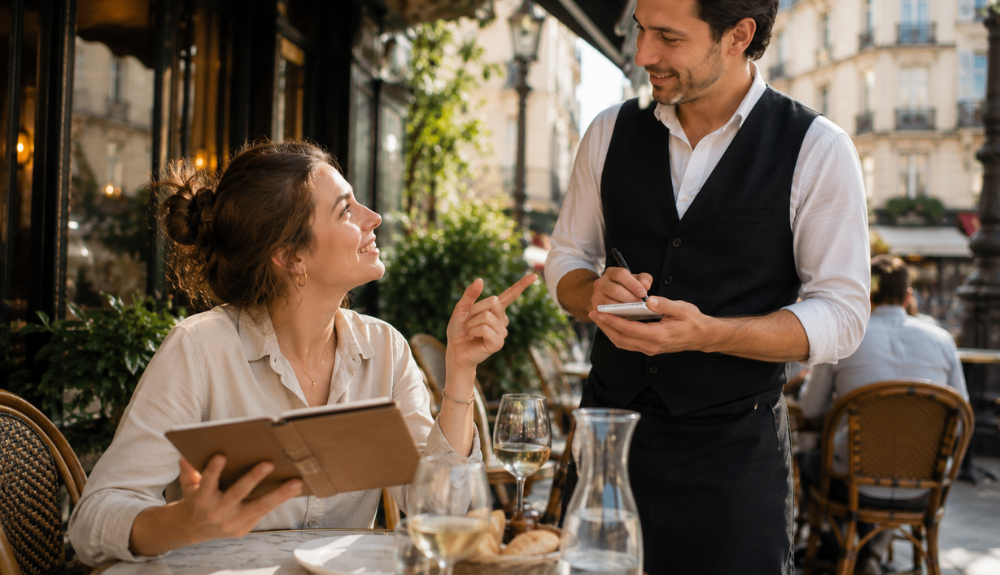
Let's be honest: this is the most important part of your trip! Being able to order food in French is a must for every traveller. Here are two sentences you should learn by heart 💘:
Je vais prendre… = I'll have…
Je voudrais… = I would like…
You'll also need some useful restaurant vocabulary. Here are a few questions a waiter might ask you:
Vous êtes combien? - How many are you?
Vous préférez en terrasse ou à l’intérieur ? - Would you prefer outside on the terrace or inside?
Vous avez choisi ? - Have you chosen?
Vous voulez une boisson ? - Would you like a drink?
Vous payez par carte ou en espèces ? - You pay by card or in cash?
And here is some useful vocabulary for you, the customer:
Une table pour deux,s’il vous plaît. - A table for two, please.
En terrasse / à l’intérieur, s’il vous plaît - Outside on the terrace / inside, please
Qu’est-ce que c’est ? - What is it?
L’entrée - Starter
Le plat principal - Main course
Le dessert - Dessert
La carafe d’eau - A jug of tap water
Je peux avoir l’addition, s’il vous plaît ? - Can I have the bill, please?
Exemple : Au restaurant
Le serveur : Bonjour madame, vous avez choisi?
La cliente : Oui, je vais prendre le magret de canard avec les frites s’il vous plaît.
Le serveur : D’accord, vous voulez une boisson ?
La cliente : Juste une carafe d’eau s’il vous plaît.
Le serveur : Très bien !
➡️Good to know: A carafe d'eau is free in French restaurants and bars. Just ask for one when ordering your meal.
Week 3: French for getting around
Once you arrive in Paris, the first thing you'll need to do is... get to your hotel! Being able to navigate French public transport is an essential travel skill. Here are a few useful phrases to have up your sleeve:
Je voudrais acheter… = I would like to buy…
Un billet de train - A train ticket
Un ticket de métro - A metro ticket
Un ticket de bus - A bus ticket
You'll also need to know how to ask for directions:
Où est… ? = Where is…?
La gare - The train station
L’aéroport - The airport
La boulangerie - the bakery
L’arrêt de bus - The bus stop
La station de métro - The metro station
La station de taxi - The taxi rank
La rue - The street
Où sont les toilettes ? - Where are the restrooms?
Je suis perdu. - I am lost.
C’est tout droit. - It’s straight ahead.
C’est à gauche. - It’s on the left.
C’est à droite. - It’s on the right.
C’est à côté de... - It’s next to…
C’est loin. - It’s far.
C’est proche - It’s close.
C’est à 5 minutes à pied - It’s 5 minutes by foot.
➡️ Here’s a short cartoon showing someone asking for directions to the train station. See how many phrases you can recognise! 🚉
Week 4: French for Shopping
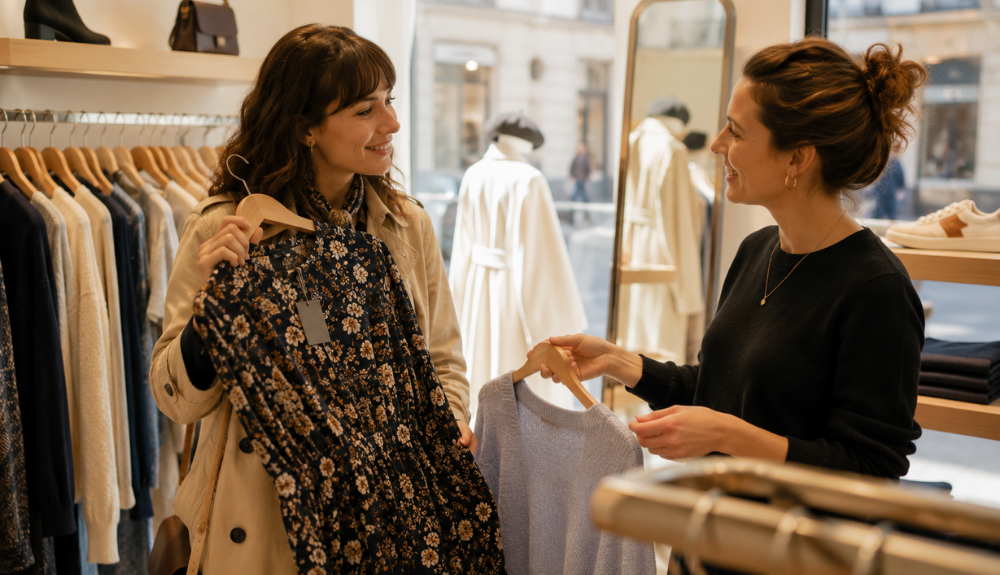
What would a trip to Paris be without a little shopping on the Champs-Élysées? Week 4 is time to learn how to handle a conversation while shopping 👛!
Here are a few useful phrases to remember:
Combien coûte… ? - How much costs… ?
Je cherche… - I’m looking for…
Vous avez la taille 36 / 38 / 40 / 42…? - Do you have size 36 / 38 / 40 / 42…?
Où sont les cabines d’essayage ? - Where are the fitting rooms?
Je paie par carte / en espèces. - I pay by card / in cash.
C’est cher ! - That’s expensive!
And here is some more useful vocabulary for shopping in Paris:
Un magasin - A shop
Un souvenir - A souvenir
Un cadeau - A gift
Une carte postale - A postcard
Un T-shirt - A T-shirt
Une robe - A dress
Une jupe - A skirt
Un pull - A sweater
Des chaussures - Shoes
Un parfum - A perfume
Des bijoux - Jewels
Finally, it's time to review numbers up to 100!
Exemple : Au magasin de souvenirs
Le vendeur : Bonjour monsieur, je peux vous aider ?
La cliente : Oui, je cherche un souvenir pour mon amie.
Le vendeur : D’accord! Voilà un t-shirt “J’aime Paris”.
La cliente : Super, vous avez la taille 38 ?
Le vendeur : Oui, voilà ! Vous payez par carte ou en espèce ?
La cliente : Je paie par carte !
Le vendeur : Parfait, merci. Au revoir !
Week 5: French for Hotels
After a long day of travelling and sightseeing, you'll be happy to know how to communicate at your hotel. Whether you're checking in, asking a question, or reporting a problem, these phrases will come in hand:
J’ai une réservation au nom de… - I have a reservation under the name…
À quelle heure est le petit-déjeuner ? - What time is breakfast? 😋
Où se trouve ma chambre ? - Where is my room?
Il y a un problème avec ma chambre. - There is a problem with my room.
Quel est le mot de passe du Wifi ? - What is the Wifi password?
More useful hotel vocabulary:
La réservation - Reservation
La chambre - Room
La chambre double - The double room
La clé - Key
Le petit-déjeuner - Breakfast
L’ascenseur - L’ascenseur
Les escaliers - Stairs
La réception - Reception
La salle de bain - Bathroom
Les toilettes - W.C
➡️Here’s a short video you can watch to practise!
Week 6: Sharing your opinion with Francophones
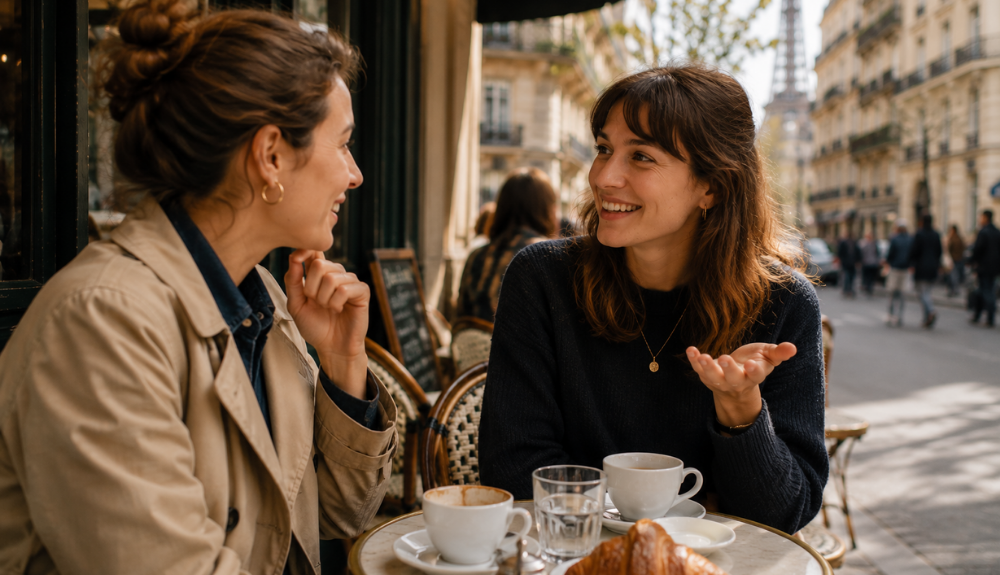
While travelling, it can be nice to connect with locals by talking about your likes, dislikes, and experiences.
Here are a few simple phrases that will help you share your opinion in French 🗣️:
Je pense que… - I think that…
J’adore… - I love…
J’aime… - I like…
Je préfère… - I prefer
Je n’aime pas… - I don’t like…
Moi aussi ! - Me too!
Je déteste… = I hate…
Le musée - Museum
Le restaurant - Restaurant
Ce plat - This dish
Le fromage - Cheese
Les escargots - Snails
Le café - Coffee
Les macarons - Macaroons
La culture française - French culture
And don't forget one of the most useful questions when having a conversation 😜:
Et toi ? = And you?
➡️Have a look at this cute little film!
Week 7: Emergency situations in France
Emergencies can happen, and they can be even more stressful when you're abroad. That's why Week 7 is all about preparing for unexpected situations, whether you get sick, lose your passport, or have something stolen:
J'ai mal… = I have pain...
à la tête - in my head
au ventre - in my stomach
aux dents - in my teeth
Je suis malade. - I am sick.
J’ai la nausée. - I feel nauseous.
J’ai envie de vomir. - I feel like vomiting.
J’ai besoin d’un médecin. - I need a doctor.
Pouvez-vous appeler une ambulance ? - Can you call an ambulance?
J’ai perdu mon passeport - I have lost my passport.
On m’a volé mon portefeuille. - My wallet has been stolen.
Où est l’hôpital le plus proche ? - Where is the nearest hospital?
Où est le commissariat de police ? - Where is the police station?
Le médecin - Doctor
L’hôpital - Hospital
La pharmacie - Pharmacy
L’ambulance - Ambulance
Les médicaments - Medication
Le passeport - Passport
Le portefeuille - Wallet
La police - Police
Les pompiers - Firefighters
Les urgences / le SAMU - Emergencies
L’assurance voyage - Travel insurance
Exemple : A la pharmacie
Le pharmacien : Bonjour monsieur, je peux vous aider ?
La cliente : Oui, j’ai mal aux dents.
Le pharmacien : D’accord! Voilà un médicament : du doliprane.
La cliente : Merci, je souhaite payer par carte.
Le vendeur : Oui, voilà !
La cliente : Merci, au revoir.
➡️ In France, you can call 18 for the fire brigade, 17 for the police, and 15 for medical emergencies. 📞
Week 8: French travel language basics—Final review
And there you go! If you've learned these French phrases for travel, you're ready to navigate your way through the country of Ratatouille with much more confidence!
Week 8 is all about reviewing everything you've learned so far. Go back over the vocabulary, phrases, and situations covered in the previous weeks and put them into practise with your tutor or language partner.
Remember: you don't need perfect French to enjoy your trip. A few useful phrases and a willingness to communicate can go a long way. Have an amazing trip, et bon voyage! 😉
➡️ Where are you planning to travel next? Let us know in the comments! ✈️