
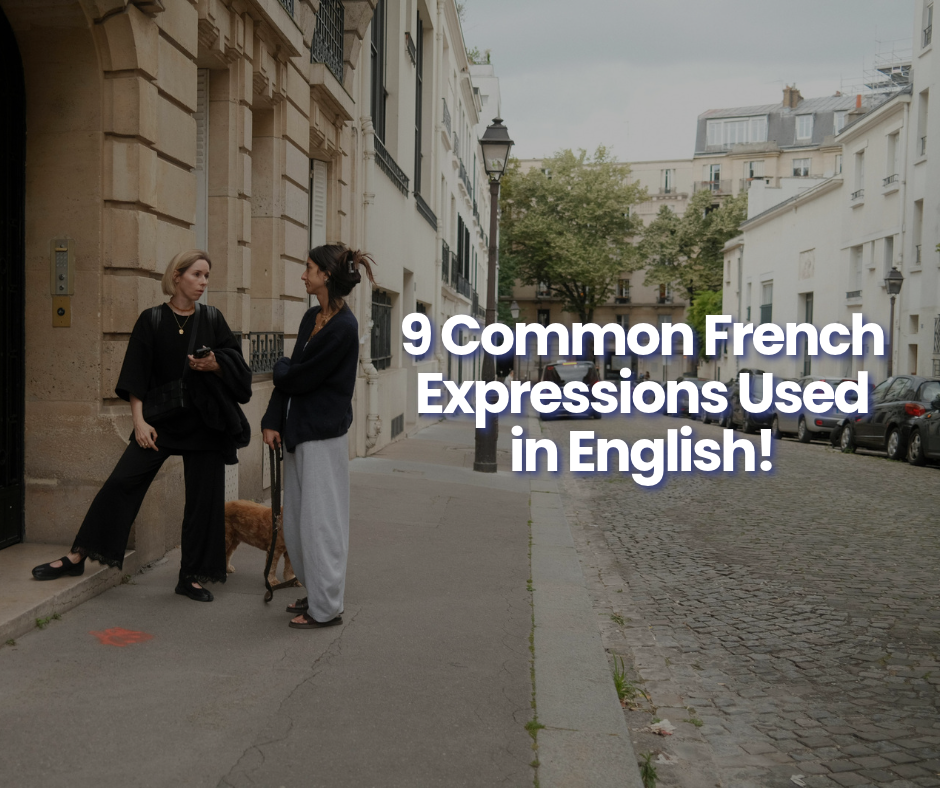
Common French Expressions
Used in English
Cliché, rendez-vous, déjà-vu… What do these three words have in common? You guessed it: they all come from your favourite foreign language! 😉
Now, if you had to name 9 common French expressions used in English, which ones would make your list? (If your first thought was Voulez-vous coucher avec moi, sorry, you're disqualified! 😝)
Not feeling particularly inspired? Don’t worry! I’ve put together a list of some of my favourites, just for you… So, let's see how many you recognise!!!
Rendezvous
In English, a rendezvous often refers to a romantic meeting or a planned get-together. But did you know that in French, rendez-vous has a much broader meaning? We use it for all sorts of appointments, whether it's a doctor's appointment, a business meeting or even a meeting with a friend.
Here are some examples:
un rendez-vous professionnel = a business meeting
un rendez-vous chez le dentiste = a dentist's appointment
un rendez-vous galant = a romantic date 😘
Déjà-vu
Have you experienced a déjà-vu recently? I have, and I always find it quite disturbing!
Just to remind you what it is: a déjà-vu is that strange feeling of having experienced a situation before, even though you know you haven’t. It’s almost as if you were reliving a scene you’ve already been through!
The term déjà-vu was first used by French philosopher Émile Boirac in the late 19th century to describe this curious phenomenon! Before that, there wasn't really a specific term for this particular feeling…
Beyoncé (Ft. JAŸ-Z) - Déjà Vu [Lyrics] #Shorts
Raison d’être
The expression raison d'être is often used in philosophical or more abstract contexts. It literally translates as "reason for being", although I have to admit it sounds a little less elegant in English! 😜
Basically, your raison d'être is your purpose in life, the reason you exist or the thing that gives your life meaning.
For example, we could say that Céline Dion's raison d'être is to sing!
➡️ Pssst, if speaking French is part of your raison d’être, feel free to contact us and we’ll help you make it happen! 😉
Je ne sais quoi
As you might have guessed, this expression ALSO comes from the language of Molière! It literally translates as "I don't know what" and is often used in sentences like: "They have a certain je ne sais quoi..."
But what does it actually mean? It refers to an indefinable quality or special charm that makes someone or something particularly appealing. It's that little something you can't quite put your finger on! ✨
Gourmet
"This dish is so gourmet!"
Sounds a bit fancy, doesn't it? The word gourmet is indeed often used in English to describe high-quality gastronomy, refined dishes or products made with particular care. But it can also refer to someone who really appreciates fine food and enjoys haute cuisine.
For example, you might hear someone say: "He's a real gourmet!" to describe a person who knows and appreciates good food. 🧑🍳
➡️ Speaking of cuisine, check out our article on French food-related idioms!
Avant-garde
In French, avant-garde describes something innovative or ahead of its time. ****It can refer to an idea, an artistic movement, an approach or even a way of thinking.
In English also, the expression is used to describe something experimental, but it's particularly common in the worlds of art, fashion and design. It refers to anything that challenges traditional ideas and pushes creative boundaries!
“Xavier Dolan's latest movie is so avant-garde!” 😎
Cliché
"Parisians are so romantic!"
"Are you kidding me? That's such a cliché!"
You've probably heard this word before, and, not surprisingly, it comes from French!
In both languages, a cliché refers to an idea, or situation that has been repeated so many times that it has become predictable and unoriginal. It can also refer to an oversimplified belief or stereotype that people tend to accept as true, even though it isn't necessarily accurate.
➡️ Did you know? In French, a cliché is also a photo. 📸
Au contraire !
Au contraire is a fancy way of saying "on the contrary" or "quite the opposite"!
I actually discovered that this expression was also used in English thanks to the TV series The Big Bang Theory. Sheldon, the show's famously pedantic character, often uses it when he wants to contradict something someone has just said.
"You can throw all the French around you wan.." The Big Bang Theory quote S02E20 Stuart
Faux-pas
A faux pas is a social mistake or an embarrassing action that goes against the accepted rules of a particular situation. For example, if you're invited to a wedding and decide to wear a white dress, that could be considered a faux pas!
In France, we also use the expression fashion faux pas to describe a fashion mistake or a poor style choice. 🫣
To sum-up: 9 common French expressions used in English
Rendez-vous = a planned meeting, often with a romantic, social or secretive connotation.
Déjà-vu = the strange feeling that you've experienced something before.
Raison d’être = one's purpose in life or reason for existing.
Je ne sais quoi = an indefinable quality or special charm. 👌
Gourmet = someone who appreciates fine food; also used to describe high-quality cuisine.
Cliché = an overused idea, phrase or stereotype.
Avant-garde = innovative, experimental or ahead of its time. 😎
Au contraire = on the contrary, quite the opposite.
Faux-pas = a social mistake or an embarrassing breach of etiquette!
And voilà! I hope this article has inspired you to incorporate more French into your daily life… Even if the language of Ratatouille isn't your whole raison d'être!
Now it's your turn! Are there any other expressions that you would have added to the list? Let us know in the comments below! 🤩⤵️