
7 French Mistakes That Can Lead To Awkward Situations!

7 French mistakes that can completely change what you mean
You think you’re saying “I’m hot”… but suddenly, your French conversation takes a very awkward turn. Why? Because some “small” grammar mistakes don’t just sound wrong—they completely change the meaning. From “Je suis chaud” to “Je couche avec mon ami”, here are our top 7 French mistakes that can lead to awkward situations (and how to avoid them 😉!).
“J’ai chaud” vs “Je suis chaud”
This is a big one. You need to be very careful with “être” and “avoir” here.
“J’ai chaud” means “I’m hot” (because of the temperature).
“Je suis chaud”, however, has a very different meaning. It can mean “I’m up for it”—or, in some contexts… “I’m horny.” 😅
Compare these two sentences:
“Il fait 40 degrés… J’ai chaud.”
= It’s 40 degrees… I’m hot.
“Je suis chaud pour aller à la soirée de Théo !”
= I’m up for going to Theo’s party!
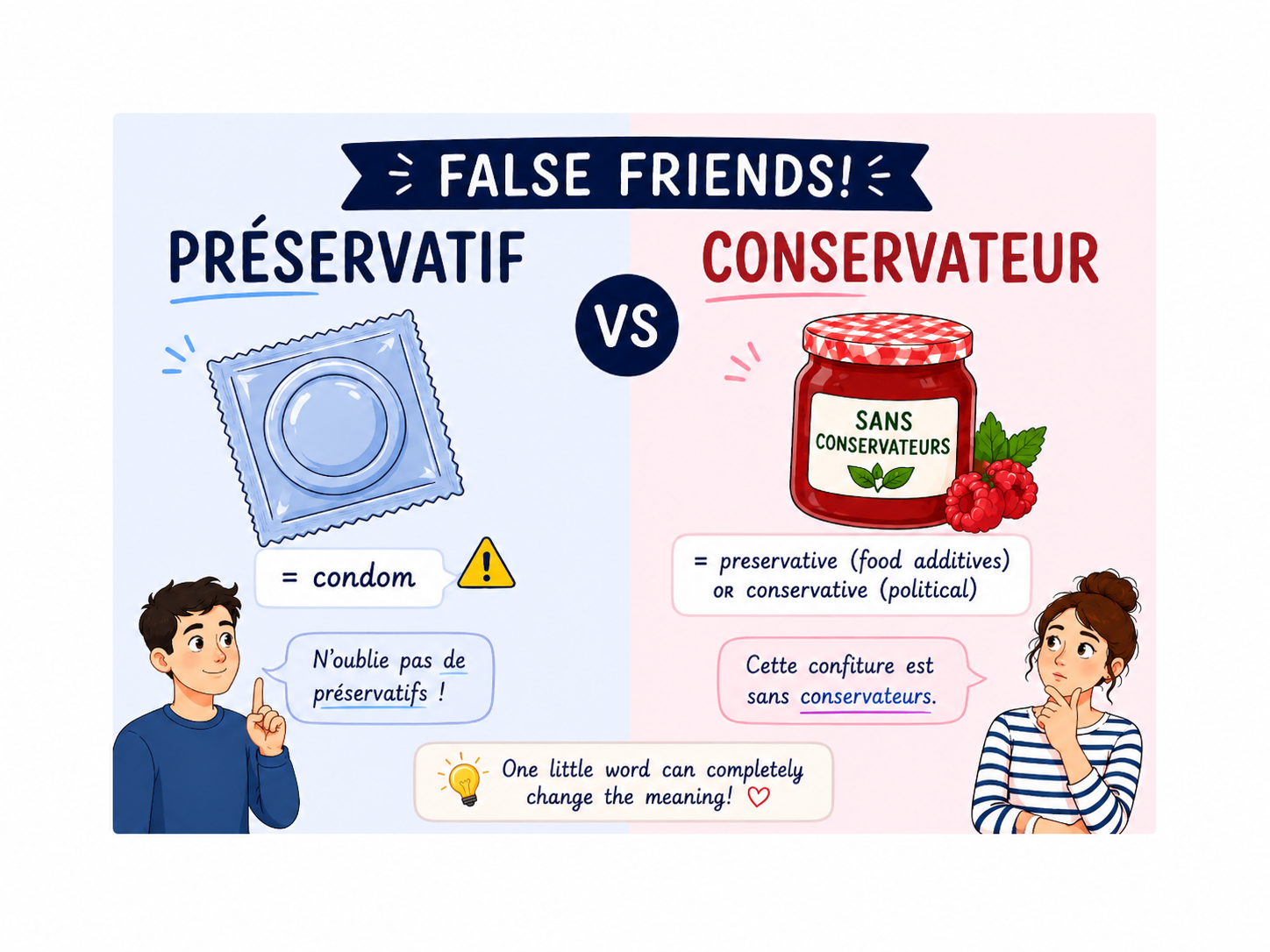
“Préservatifs” vs “Conservateurs”
This is a classic French false friend—and one you definitely want to get right!
“Préservatif” means “condom”. ⚠️
“Conservateur” means “preservative”, as in food additives, or “conservative” (politically or socially).
Mixing these up can lead to some very confusing (yet hilarious) situations—especially when talking about food safety or… well, other kinds of safety!
➡️ Discover more English-French false friends in this article!
“Je me couche” vs “Je couche”
This is a very common mistake among my students. It all comes down to the difference between the reflexive verb “se coucher” and the non-reflexive verb “coucher.”
“Se coucher” means “to go to bed”.
“Coucher” however, usually means “to sleep with someone.”
Compare these two sentences:
“Il est minuit… Je vais me coucher avec mon copain.”
= It’s midnight… I’m going to bed with my boyfriend.
“Il est minuit… Je vais coucher avec mon copain.”
= It’s midnight… I’m going to have sex with my boyfriend.
See how one tiny word can completely change the meaning? 😂
“Il pleure” vs “Il pleut”
These two French phrases sound almost identical—but watch out for that sneaky ending!
“Il pleure” means “He’s crying”.
“Il pleut” means “It’s raining”.
➡️ Pro tip: For “pleure” we pronounce the ending -rrr as in tear! 😢
Whereas for “pleut”, the final consonant is silent.
“Un canard” vs “Un connard”
Let me give you an example of how just one tiny letter can completely change the meaning of a word in French.
“Un canard” means “a duck”.
“Un connard” means “a moron”... It’s a really bad insult! 🙃
“Le poisson” vs “Le poison”
On a different note… One letter can also turn your dinner into a tragedy.
“Le poisson” means “the fish”.
“Le poison” means “the poison”. 💀
➡️ Pay attention to the pronunciation: in “poisson”, you hear a strong -sss sound, while in “poison”, it sounds like a -z.
🗣 Want to hear the difference in real life? Sophie has a quick pronunciation clip that makes it crystal clear:
“Beaucoup” vs “Beau cul”
Did you know that in French, a simple “thank you” can turn into a compliment… or an awkward moment? Here’s a video that gives you an idea of what I mean!
“Merci beaucoup” means “Thank you very much”.
“Merci beau cul” means “Thank you nice ass”. 😳
Why? Because “cul” is slang for “butt.” And here’s another classic pronunciation trap:
“J’ai mal au cou” means “my neck hurts.”
“J’ai mal au cul” means… “my butt hurts.”
➡️ Pro tip: “cou” sounds like -coo, while “cul” is shorter and sharper—a bit like -kûh.”
French mistakes that can lead to awkward situations: quiz time!
Test your knowledge with these questions:
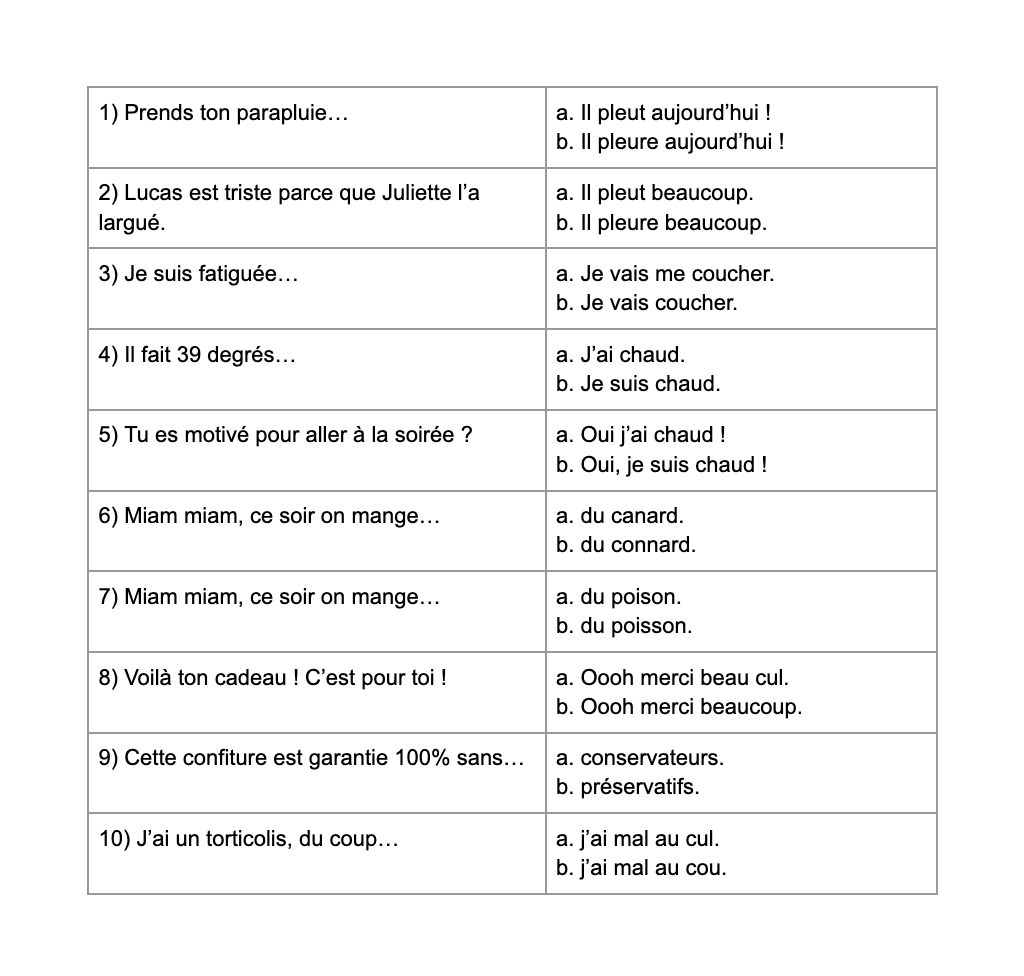
Here are the answers!
1 ⇒ a (Take your umbrella… It’s raining today!)
2 ⇒ b (Lucas is sad because Juliette dumped him. He’s crying…)
3 ⇒ a (I’m tired… I’m going to bed.)
4 ⇒ a (It’s 40 degrees… I’m hot.)
5 ⇒ b (Are you up for the party? Yes I’m all for it!)
6 ⇒ a (Yum yum, tonight we’re having duck for dinner.)
7 ⇒ b (Yum yum, tonight we’re having fish for dinner.)
8 ⇒ b (Here’s your gift! It’s for you! Oooh thank you very much.)
9 ⇒ a (This jam is guaranteed to be 100% free of preservatives.)
10 ⇒ b (I have a stiff neck, so my neck hurts.)
Et voilà ! You should now be ready to travel to France while avoiding a few cringe-worthy moments… although, let’s be honest, you’ll probably still have some—it wouldn’t be an adventure otherwise! 😉
What about you? Have you ever had an awkward moment while traveling? Can you think of any other hilarious expressions to add to the list? Let us know in the comments!
➡️ Want to start reading in your favourite foreign language? Check out our article on