
Anzac Day in France: How the French still remember
Anzac Day in France: How the French never forgot Australia’s Soldiers
For Australians, April 25 is more than just a date—it’s the Australian and New Zealand Army Corps Day, a day to remember the bravery of those who served in war. But did you know it is also commemorated on the other side of the world? Anzac Day in France still holds a special place, especially in the town of Villers-Bretonneux… Here’s the story.
The origins of Anzac Day
What is Anzac Day?
Anzac Day is held on April 25 each year to honour Australians and New Zealanders who have served and died in wars, conflicts, and peacekeeping operations.
It is one of the most important national days in Australia, as it pays tribute to the bravery and sacrifice of these soldiers—known as ANZACs.
➡️Did you know? Each year, France and Australia compete in the Anzac Cup match!
Why is it celebrated on April 25
The date marks the anniversary of their first major military action during World War I. On April 25, 1915, young soldiers from Australia and New Zealand landed at Gallipoli (in present-day Turkey), on the other side of the world. 🌍
It was a tragic day: in 24 hours, nearly 900 young men lost their lives on those distant shores…
Three years later, in 1918, Australian troops played a decisive role in halting the German advance at Villers-Bretonneux, in northern France. Their action helped protect the nearby city of Amiens and marked a turning point in the fighting on the Western Front.
Australian soldiers played a key role in the Allied victory during WWI. And just imagine… All those young men who had travelled from the other side of the world to fight in Europe… Anzac Day is a way to remember their courage, their sacrifice, and their lasting contribution.
➡️ Curious about the history of the land of baguette? Learn more about Bastille day!
What happens on Anzac Day in France

Villers-Bretonneux - Monument Aux Morts / Credit: By René Hourdry - Own work, CC0, https://commons.wikimedia.org/w/index.php?curid=147529824 )
The Villers-Bretonneux Dawn Service
Every year on April 25th, France honors the Anzac soldiers at the Australian War Memorial in Villers-Bretonneux, near Amiens. The ceremony, known as the Dawn Service, begins at 2:30 a.m. and continues until dawn, mirroring the timing of the original ANZAC landing in 1915.
The memorial bears the names of 10,729 Australian soldiers who lost their lives during World War I and have no known grave... These soldiers were affectionately called "Diggers”.
On April 26, the city also organizes a commemorative walk following in the footsteps of the soldiers as a tribute to their memory.
The Digger memorial in Bullecourt
In the afternoon, additional ceremonies take place in the town of Bullecourt, in the Pas-de-Calais region, which was the site of two major battles involving Australian troops.
These ceremonies are called the Digger Service. They are held at the Digger Memorial and the Square du Souvenir Français in Bullecourt.
The following Sunday, other commemorations take place in Le Quesnoy, Longueval and other cities in the Somme region, where Anzac troops also played a pivotal role during the war.
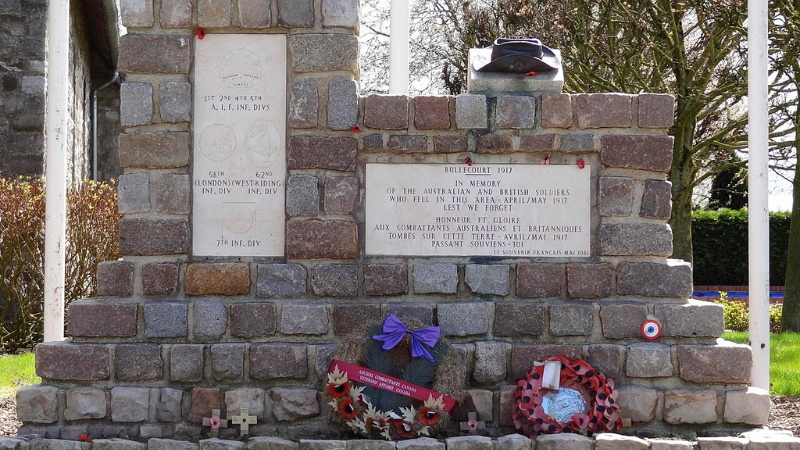
Bullecourt - Australian Monument / Credit: Liondartois, CC BY-SA 3.0 <https://creativecommons.org/licenses/by-sa/3.0>, via Wikimedia Commons
The lasting Franco-Australian connection
Visiting Sir John Monash Centre and the Viller-Bretonneux War Cemetery
The Sir John Monash Centre was built in 2018 on the site of the Battle of Villers-Bretonneux. It tells the story of Australian soldiers and their experience on the Western Front during WWI.
Visiting the museum is a deeply moving experience… Just to give you an idea, in total, around 295,000 young Australians served, and 46,000 lost their lives.
Nearby, the Villers-Bretonneux Military Cemetery holds around 2,000 graves of Commonwealth soldiers, as well as a war memorial dedicated to the 11,000 who have no known grave, as I said previously.
➡️Have you ever heard about back to school time in the Hexagon?
The touching story of Victoria school
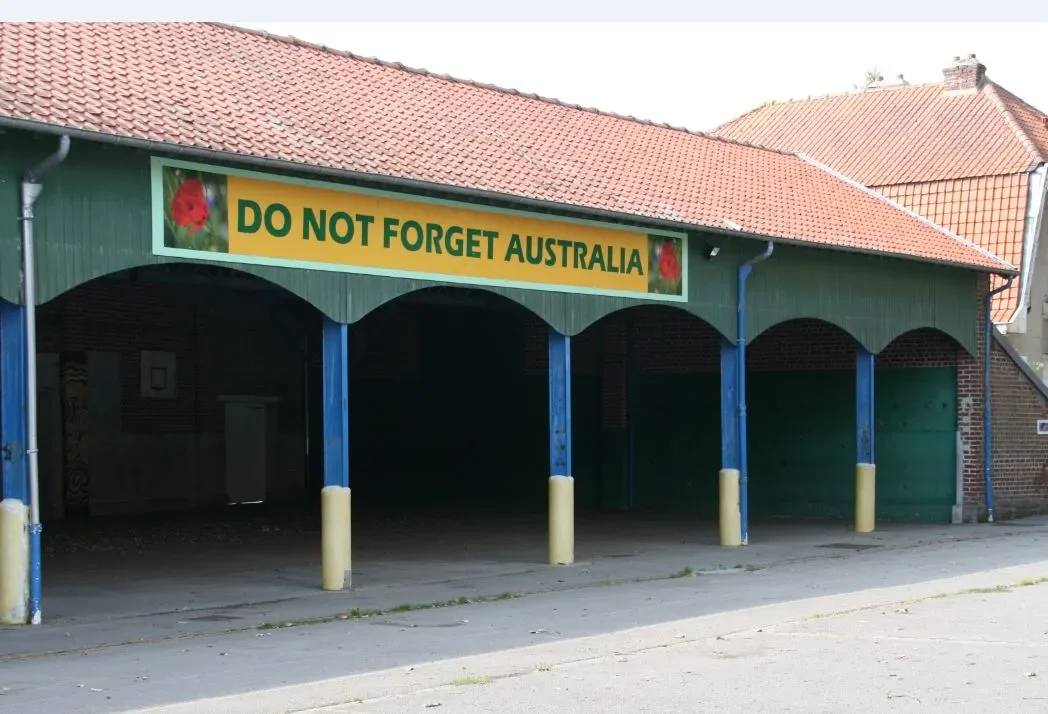
Villers-Bretonneux - Ecole Victoria / Credit: Copyright Musee Franco-Australien https://www.museeaustralien.com/
On a more positive note, the city of Villers-Bretonneux is twinned with Robinvale, in Victoria! 🤝
And, together, they were the first official partnership between a French and an Australian town. Each year, many events bring people together, including exchanges between residents of both countries! This relationship between the two towns is deeply rooted in history, and it comes with a cute side story…
After WWI, Australian soldiers, returning home after witnessing the horrors of war, decided to organize a fundraiser to help rebuild a local school in Villers-Bretonneux. They succeeded! And guess what?
The school is still active today 🥰! It was named “École Victoria,” and above its courtyard, a large plaque bears the words: “Do not forget Australia.” This is also written in every classroom! A powerful quote on the school’s façade tells the story in English and French. Here’s what’s written:
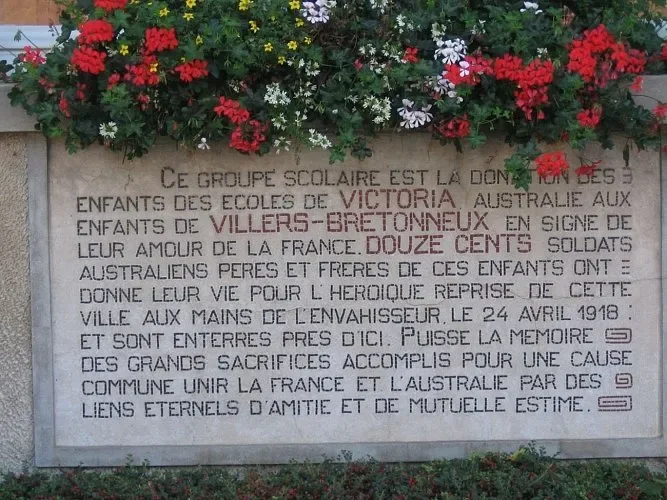
Villers-Bretonneux - Ecole Victoria / Credit: Copyright Musee Franco-Australien https://www.museeaustralien.com/
“This school building is the gift of the schoolchildren of Victoria, Australia, to the children of Villers-Bretonneux as a proof of their love and good-will towards France. Twelve hundred Australian soldiers, the fathers and brothers of these children, gave their lives in the heroic recapture of this town from the invader on 24th April 1918 and are buried near this spot. May the memory of great sacrifices in a common cause keep France and Australia together forever in bonds of friendship and mutual esteem.”
And the story doesn’t end there… Because almost a decade later, in 2009, pupils from Villers-Bretonneux returned the gesture by raising funds for a school destroyed by bushfires in Victoria. 🥹 They gathered 14,000 euro to rebuild this school in Strathewen!
➡️ The pupils of this French school painted a giant mural in the Aboriginal style as a tribute.
Today, this bond between our two countries is celebrated, not only by remembering the past, but also through cultural, sporting events, traveling, school exchanges that bring together students from one continent to another… And of course, Australians who are learning French and vice-versa 😉!
And after all the horrors of war, it’s beautiful to see this friendship alive and thriving. 🌏
Are you going to commemorate Anzac Day? Tell us how in the comments!
A quick thank you
A big thank you to the Musée Franco-Australien for kindly giving us permission to use some of their beautiful photos to illustrate this article. If you’d like to learn more about the Franco-Australian story — and the people and places keeping it alive — I really recommend visiting their website.